

Adobe Commerce pricing is one of the least transparent topics in ecommerce. Adobe doesn’t publish a price list, partners rarely quote in public, and most “cost breakdowns” online stop at the licence fee. They skip the three or four other layers that decide what you actually spend.
This guide covers every layer: licence, hosting, development, extensions, integrations and maintenance. It also shows where mid-market retailers underestimate total cost, and what to ask before you sign.
Why the price is hard to find
Adobe Commerce (formerly Magento Commerce) is sold through Adobe’s partner network. Pricing is negotiated, not listed, and depends on gross merchandise volume (GMV), number of storefronts, edition (cloud or on-premise) and contract length.
Adobe sells to everyone from mid-market retailers with a few million in revenue to enterprises with hundreds of millions. One public price would anchor most of them in the wrong place. The result is that most buyers start their first conversation with no realistic number in mind, and the licence is only part of the bill.
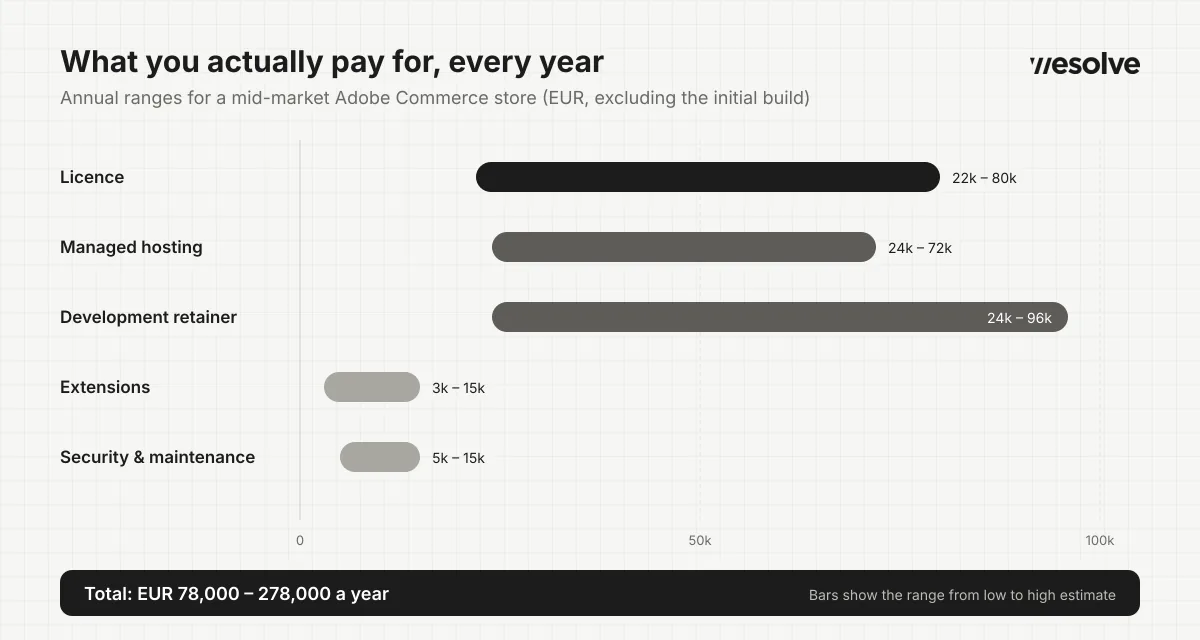
The cost layers
1. Licence
Licensing is based on GMV. Partner and reseller estimates in 2026 put the annual licence for a mid-market retailer (roughly EUR 5M to 50M GMV) between EUR 22,000 and 80,000. Above EUR 50M GMV it typically passes EUR 100,000 a year.
Treat these as indicative. Your quote depends on negotiation, contract length and edition. Adobe Commerce Cloud includes hosting on Adobe’s infrastructure; Adobe Commerce on-premise does not. That difference changes the whole cost structure.
2. Hosting and infrastructure
This is where most estimates fall apart.
On Adobe Commerce Cloud, hosting is part of the licence. That’s convenient, but you pay for infrastructure you can’t tune, with scaling decided by Adobe’s operations team rather than by engineers who know your code.
On-premise, or on Magento Open Source with no licence at all, you pay for hosting separately:
- Basic managed hosting: EUR 500 to 2,000 a month. Fine for low traffic, not for a mid-market store with seasonal peaks.
- Dedicated managed hosting with autoscaling and commerce-specific setup: EUR 2,000 to 6,000 a month. This is the realistic range for a store that must stay up on Black Friday.
- Self-managed cloud on AWS, GCP or Azure: cheaper on paper, but only if you have engineers who know Magento’s infrastructure. Most mid-market retailers don’t.
Most agencies don’t run hosting. They build the store and hand it to a separate provider, which creates the accountability gap behind slow incident response. More on that in Magento managed hosting in 2026.
3. Development and implementation
Licence and hosting recur every year. Development is mostly a project cost, plus ongoing work. Realistic 2026 ranges for a mid-market build:
- New store (custom theme, core integrations, standard extensions): EUR 40,000 to 120,000
- Replatform from Magento 1 or another platform: EUR 50,000 to 150,000, depending on data and custom features
- Hyvä frontend migration from Luma, for Core Web Vitals: EUR 15,000 to 50,000
On top of that, a development retainer for regular features, patches and performance work typically runs EUR 2,000 to 8,000 a month.
4. Extensions
The Adobe Marketplace covers search (Algolia, Klevu), loyalty, subscriptions, B2B quoting and much more. Budget EUR 3,000 to 15,000 a year for extension licences. Some are one-off purchases, others are annual subscriptions, and they add up faster than most buyers expect.
5. Integrations
ERP, PIM and payment integrations are often the largest hidden cost.
A clean ERP integration, whether SAP, Microsoft Dynamics or a mid-market ERP like SoftOne or Entersoft, typically costs EUR 15,000 to 40,000 to build properly. Payment gateways for Greece and Southeast Europe add EUR 3,000 to 10,000, depending on the provider and checkout. A proper two-way PIM integration needs its own budget too.
6. Maintenance and security
Applying security patches correctly on a customised store needs an engineer who knows the codebase, not a generic script. Typical annual costs:
- Security patches and minor updates: EUR 5,000 to 15,000
- Monitoring and incident response: included in higher-end managed hosting, billed separately at the lower end
- Minor version upgrades: EUR 3,000 to 10,000, depending on how customised the store is
Total cost of ownership
Put together, a mid-market retailer on Adobe Commerce on-premise, with a managed hosting partner and a development retainer, should budget:
| Cost layer | Per year (EUR) |
|---|---|
| Adobe Commerce licence | 22,000 – 80,000 |
| Managed hosting | 24,000 – 72,000 |
| Development retainer | 24,000 – 96,000 |
| Extensions | 3,000 – 15,000 |
| Security and maintenance | 5,000 – 15,000 |
| Total, excluding the initial build | 78,000 – 278,000 |
The range is wide because stores differ. A single storefront with moderate customisation and one competent partner sits at the low end. Several storefronts with deep ERP integration and a fragmented vendor setup sit at the high end, often without anyone noticing until the invoices arrive.
Where retailers overspend
A fragmented vendor setup. You pay an agency to build, a host to run and a support vendor to fix. When something breaks, all three spend time blaming each other before anyone fixes it, and that time costs revenue.
Cheap hosting. Saving EUR 500 a month on shared hosting, then spending EUR 20,000 on emergency response after a Black Friday outage, doesn’t add up.
Deferred maintenance. Skipping a security patch to save money tends to look expensive in hindsight.
Cloud or on-premise?
Adobe Commerce Cloud includes hosting, so its sticker price looks higher, but it removes a hosting line and simplifies vendor management. If you’re comfortable with Adobe’s infrastructure and its limits, it can be a sensible choice.
If you need infrastructure tuned to your codebase, autoscaling sized to your real traffic, and engineers who understand the application during an incident, on-premise with a capable managed hosting partner is usually better. The real question isn’t which edition is cheaper. It’s who owns the infrastructure, and whether they also own the code.
Magento Open Source as an alternative
Magento Open Source has no licence fee. It lacks some of Adobe Commerce’s native B2B features, content staging and preview tools, and Adobe product integrations.
For mid-market B2C retailers those gaps are often manageable. For B2B operations, or teams that rely on Page Builder and content staging, the missing features usually justify the licence. Development and hosting cost the same on both; only the licence differs.
Five questions to ask before you sign
- Who owns the hosting? If it goes to a third party, ask what happens when the store goes down at 2am on a Saturday.
- What is the incident response time, and who responds? An automated alert is not an engineer who knows your code.
- What does the maintenance retainer cover? Patches, upgrades and performance monitoring should be explicit line items.
- What is the uptime SLA, and is it measured? Ask for measured uptime across their production clients.
- Who fixes an integration that fails mid-sync, and how fast?
How we approach it at wesolve
We’re an Adobe Commerce certified partner. We build on Magento Open Source and Adobe Commerce, host stores on infrastructure we operate ourselves, and manage 27 live storefronts in 6 countries at 99.98% measured uptime.
One team writes the code, runs it and fixes it when something goes wrong. That matters for cost as well: you pay one partner for development and infrastructure, not three vendors arguing about whose fault an outage was. For projects that need PIM, OMS, CIAM or DAM, CommerceSuite provides them already connected to Magento, which cuts launch time from quarters to weeks.
Evaluating Adobe Commerce, or rethinking your current setup? Talk to us, or read how we think about agency and infrastructure in the Greek market.
FAQs
What does Adobe Commerce cost a mid-market retailer per year? Adobe doesn’t publish prices. Based on partner estimates in 2026, the licence for EUR 5M to 50M GMV is typically EUR 22,000 to 80,000 a year. Total cost of ownership, including hosting, a development retainer and maintenance, usually runs EUR 78,000 to 278,000 a year.
Does Adobe Commerce include hosting? Adobe Commerce Cloud does. On-premise does not, and needs a separate managed hosting partner, typically EUR 2,000 to 6,000 a month for a mid-market store with autoscaling and 24/7 monitoring.
How does Adobe Commerce compare with Magento Open Source on cost? Open Source has no licence fee; Adobe Commerce has an annual GMV-based licence. Development and hosting costs are similar. Adobe Commerce adds B2B features, staging and Adobe integrations that Open Source lacks.
Why isn’t Adobe Commerce pricing public? Adobe sells through partners and negotiates on GMV, contract length and number of storefronts. One public price wouldn’t fit the range of buyers it serves, which is common for enterprise software.
What hidden costs should I watch for? ERP and PIM integration work (EUR 15,000 to 40,000 each), extension licences (EUR 3,000 to 15,000 a year), and the ongoing cost of a fragmented vendor setup. Deferred security patching is a risk that gets expensive when it lands.