

Headless commerce on Magento sounds great on paper: decouple the frontend, ship faster, own the UI completely. But the gap between an architecture diagram and a production storefront is exactly where projects get expensive.
This is how headless actually works on Magento 2, what GraphQL and PWA Studio bring, and the tradeoffs to weigh before you commit.
What “headless” means on Magento
In a standard setup, Magento renders the HTML, runs the theme and serves the page. Go headless, and Magento becomes the commerce engine (catalog, cart, checkout, orders, accounts), while a separate React, Vue or similar app talks to it through an API.
Magento 2 offers REST and GraphQL. For headless frontends, GraphQL is the standard choice: the frontend asks for exactly the data it needs in one call instead of chaining REST endpoints.
What GraphQL covers, and where it stops
Magento’s GraphQL API now covers the core of a working storefront:
- Product queries, including configurable, bundle and grouped products
- Category trees and layered navigation
- Cart: add, update, remove, coupons
- Checkout: shipping, payment, order placement
- Customer login, account data and order history
- CMS blocks and pages
The gap is custom code. Custom modules don’t expose their data through GraphQL automatically. Custom attributes, third-party integrations and bespoke catalog logic all need resolvers written, and that work is consistently underestimated in scoping.
Adobe Commerce extends the schema for B2B (company accounts, requisition lists, negotiated quotes). For B2B, the coverage difference between Open Source and Adobe Commerce matters.
Your frontend options
| Option | What it is | Fits when | Watch out for |
|---|---|---|---|
| PWA Studio | Adobe’s React framework with the Venia reference store | You want Magento wiring pre-built | Opinionated; extending it means learning its Targets model; small ecosystem |
| Next.js + GraphQL | Your own React app on Magento’s API | Strong React team wanting full control | You write more of the Magento integration |
| Alokai (Vue Storefront) | Framework-agnostic headless frontend | You want a bigger community than PWA Studio | Another abstraction layer between you and Magento |
| Hyvä | Lightweight server-rendered theme (Alpine.js + Tailwind) | Speed is the main goal | Not headless; often confused with it |
PWA Studio handles login, cart persistence, checkout and product pages against Magento’s schema out of the box, and ships as a Progressive Web App. But performance isn’t automatic: a poorly built PWA Studio store can score worse than a well-tuned Luma or Hyvä one.
The real tradeoffs
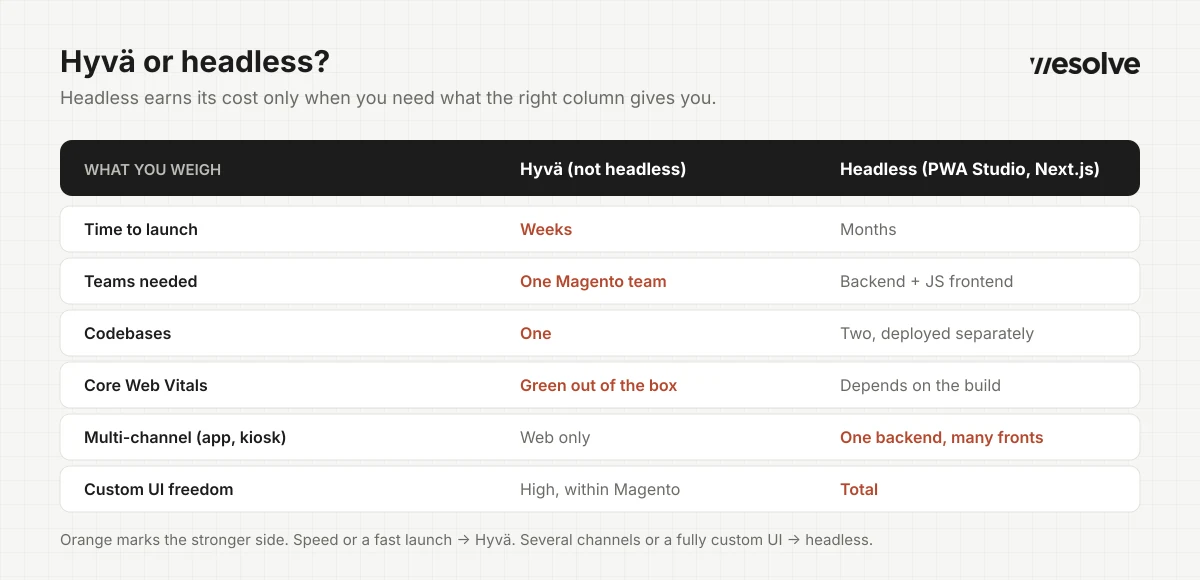
Two skill sets. A headless build needs Magento backend developers and frontend JavaScript developers working tightly on one API contract. If your team is strong on one side and thin on the other, the integration points are where projects stall.
Longer to launch. Resolvers for custom features, a frontend built from scratch, then testing and tuning. A Hyvä build can reach production in weeks; a full headless build usually takes months. If you’re up against a Black Friday deadline or escaping a failing platform, launch on Hyvä and decouple later.
Two codebases to maintain. Every Magento patch or schema change must be checked against the frontend, and your pipeline deploys two apps. Small per incident, but recurring. This is where it helps when the team that wrote the resolvers also runs the infrastructure: a schema change doesn’t turn into a dispute between your dev agency and your host.
Headless is not automatically fast. It gives you more control over performance, not a guarantee. Server-side rendering, hydration, image handling and bundle size all need deliberate work. If speed is the goal, Hyvä gets you to green Core Web Vitals faster and with less complexity.
SEO depends on rendering. Client-side React apps used to hurt indexing. Server-side rendering in Next.js and similar frameworks mostly fixes this, but only when set up correctly. Settle your rendering strategy before you build, not after.
When headless makes sense
Headless earns its complexity when:
- You need a custom frontend experience Magento’s theming can’t deliver
- One Magento backend must serve several channels: web, app, kiosk
- Your frontend team is strong in React or Vue and you want them free of Magento’s PHP constraints
- You have the timeline and budget for the extra complexity
It’s usually not the right call when the goals are faster pages, a cleaner codebase or a quicker launch. Those are better served by Hyvä. And for a first-time Magento build, get the commerce layer stable first; you can always decouple the frontend later.
Get the backend right first
Headless is an architecture decision, not a platform decision. A headless frontend doesn’t fix a slow database, a poorly indexed catalog or infrastructure that can’t take traffic spikes. If headless is part of a wider replatform, separate the two decisions: get Magento right, then decide how to serve the frontend.
At wesolve we build Hyvä, PWA Studio and custom Next.js frontends, and the same engineers run the infrastructure they deploy onto. See how we work.
FAQs
What’s the difference between headless and standard Magento? In standard Magento, Magento renders the pages. Headless, Magento handles commerce logic and exposes it through an API (usually GraphQL), and a separate frontend app does the rendering.
Is PWA Studio the best headless option in 2026? It depends on your team. PWA Studio handles Magento wiring well; Next.js gives more flexibility and a larger ecosystem; Alokai has an active community. Choose by your frontend skills and how much you need to customise.
Does headless improve Core Web Vitals? Not automatically. A badly built PWA can score worse than a well-built theme. For performance alone, Hyvä is usually the faster path.
How long does a headless build take? A Hyvä build can launch in weeks. A full headless build usually takes several months, depending on catalog complexity, integrations and team experience.
Should I go headless when replatforming to Magento for the first time? Generally no. Get the commerce layer stable on Hyvä first, then move to headless later if you need it.