

A distributor runs 4,000 SKUs across 12 customer tiers, each with its own prices, minimum orders and payment terms. Quotes are handled by email. The ERP pushes stock twice a day, and half the updates fail silently.
That’s not a catalog problem; it’s an architecture problem. The edition you choose decides whether you solve it or paper over it.
What a B2B catalog actually needs
A real B2B catalog isn’t a product list behind a login. It needs:
- Customer-specific pricing: per account, tier or contract
- Company accounts: several buyers under one account, with approvals and spending limits
- Quotes: negotiate price before checkout, not just apply a coupon
- Payment terms: net 30, net 60, credit limits, purchase orders
- Requisition lists: reorder without rebuilding a cart
- Restricted visibility: some products only for some accounts
- Minimum quantities and increments, enforced by the catalog
What Magento Open Source gives you
The foundation, not the full stack. Out of the box: customer groups with group pricing, tiered (quantity) pricing, customer accounts with order history, tax classes per group and basic visibility rules.
That covers simple B2B: resellers who all get the same wholesale price, or quantity breaks.
Not included natively: company accounts with roles, negotiable quotes, requisition lists, purchase orders with approvals, shared catalogs, and account-level credit and terms.
What Adobe Commerce B2B adds
Adobe Commerce ships a first-party B2B module, built and maintained by Adobe, wired into catalog, checkout and customer management:
| Feature | What it does |
|---|---|
| Company accounts | One parent account, many buyers, each with roles, permissions, spending limits and approval chains |
| Shared catalogs | Each company sees its own product set and prices, from one catalog, with no duplicate SKUs |
| Negotiable quotes | Buyer requests, sales responds with a price; the negotiation lives in the platform, not in email |
| Purchase orders | A payment method with approval routing before the order commits |
| Requisition lists | Saved lists for fast reordering |
| Company credit | Credit limits, outstanding balance and payment terms per account |
Extensions vs the native module
On Open Source you can buy extensions for quotes, company accounts and requisition lists. They look cheaper at the start. Over 24 months, the picture changes:
- Different vendors, different data models. Reporting across them needs custom work.
- Three patch cycles instead of one. Every Magento security release, each vendor updates on its own schedule.
- ERP integrations are built against extension data. If you later move to Adobe Commerce, that connector must be rebuilt, because company accounts and shared catalogs don’t exist as objects in Open Source.
The native module gives one coherent data model for your ERP to map against, and upgrades are Adobe’s job. ERP patterns are in Magento ERP integration.
Choosing
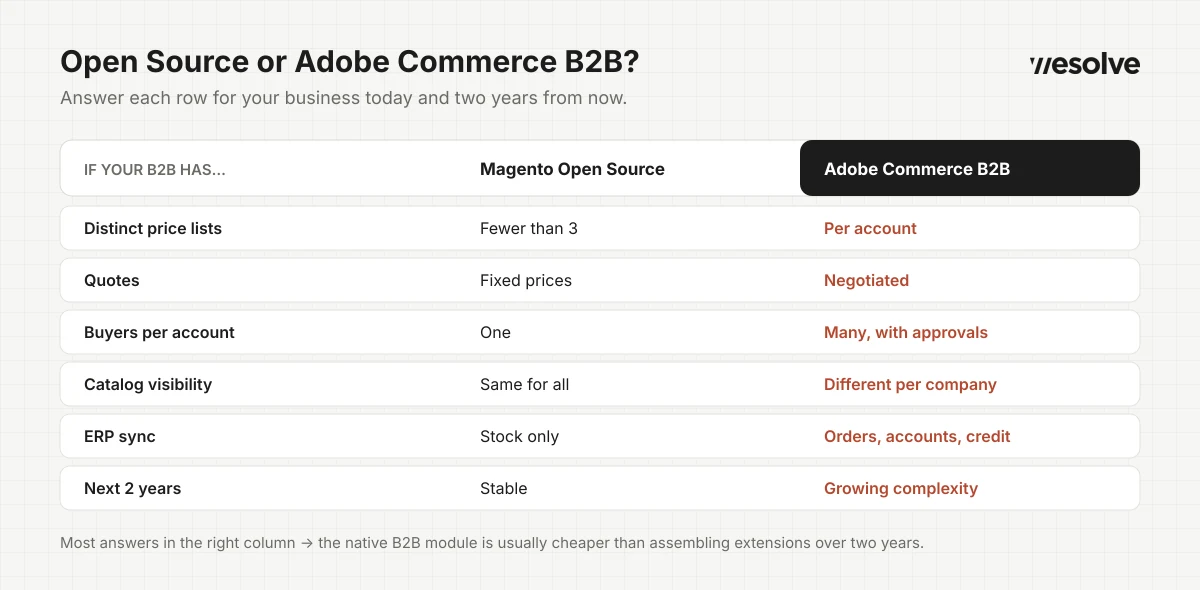
Start with Open Source if:
- Fewer than three distinct price lists
- No quote negotiation
- One buyer per account
- ERP sync is stock only
Move to Adobe Commerce B2B if:
- Per-account pricing or shared catalogs
- Quote negotiation is part of how you sell
- Company accounts with sub-buyers and approvals
- ERP sync covers orders, accounts and credit
- You expect account or SKU complexity to grow materially in the next two years
The test is whether your B2B needs are genuinely complex or just a bit more than B2C. A wholesaler selling to 50 accounts at a flat 20% off doesn’t need Adobe Commerce. A distributor with 200 accounts, individual price lists, credit terms and multi-buyer companies does. Licence costs are covered in Adobe Commerce pricing.
The build matters as much as the edition
A misconfigured shared catalog leaks prices to the wrong accounts. A quote flow not connected to the ERP creates orders that don’t match stock. A company structure that doesn’t mirror your real sales hierarchy creates approval bottlenecks your team works around by phone.
The most common pattern: a B2B store built for the demo, not the operation. The features are there, but configured with platform defaults instead of your actual account structure.
Where a complex B2B build also needs PIM, OMS, CIAM or DAM, wesolve’s CommerceSuite provides them already connected to Magento, so that layer doesn’t start from scratch. Working through this decision? Talk to us.
FAQs
Can I run B2B on Magento Open Source? Yes, for simpler needs: a few fixed customer groups, no negotiated quotes and flat accounts. Risk grows with complexity, ERP depth and the number of extensions.
Is Adobe Commerce B2B worth it for a mid-market distributor? With per-account price lists, multi-buyer companies and quote-based selling, the licence is often cheaper over 24 months than building and maintaining the same thing with extensions.
What is a shared catalog? An Adobe Commerce B2B feature that gives each company its own product set and prices, served from one catalog without duplicate SKUs.
B2B now, B2C later: which edition? For one platform serving both, Adobe Commerce is the stronger foundation. Open Source can do both, but B2B via extensions alongside B2C adds maintenance.