

Slow stores lose money. That isn’t a hypothesis; it’s one of the most consistently replicated findings in ecommerce research, across industries, markets and traffic levels.
If you run Magento or Adobe Commerce, you’ve probably felt it: bounce rates up after a slow deploy, conversions down during a traffic peak. The research adds precision: how much speed is worth, where the damage concentrates and which metrics actually matter.
The core finding: speed and conversion move together
The relationship isn’t linear, but it is consistent:
- Deloitte’s “Milliseconds Make Millions” study found that a 0.1-second faster mobile site lifted retail conversions by about 8%.
- Portent’s analysis found pages that load in one second convert several times better than pages that load in five.
- Google’s research found that 53% of mobile visits are abandoned when a page takes longer than three seconds to load.
The mechanism is simple: slow pages frustrate people, frustrated people leave, and sessions that end early don’t convert.
Where slow pages cost the most
Category and product pages. They carry the most search traffic and the most price-sensitive visitors. A slow category page loses people before they’ve seen a single product.
Checkout. The most expensive place to be slow. The shopper has already decided to buy; friction here loses a completed order, not just a session. Slow infrastructure also shows up as timeouts, dropped sessions and payment gateway errors.
Mobile. Most ecommerce traffic is mobile, and mobile LCP scores still lag desktop by a wide margin for most mid-market stores. A store that’s fast on desktop and slow on mobile is running two businesses, and one of them is broken.
The three metrics that predict revenue
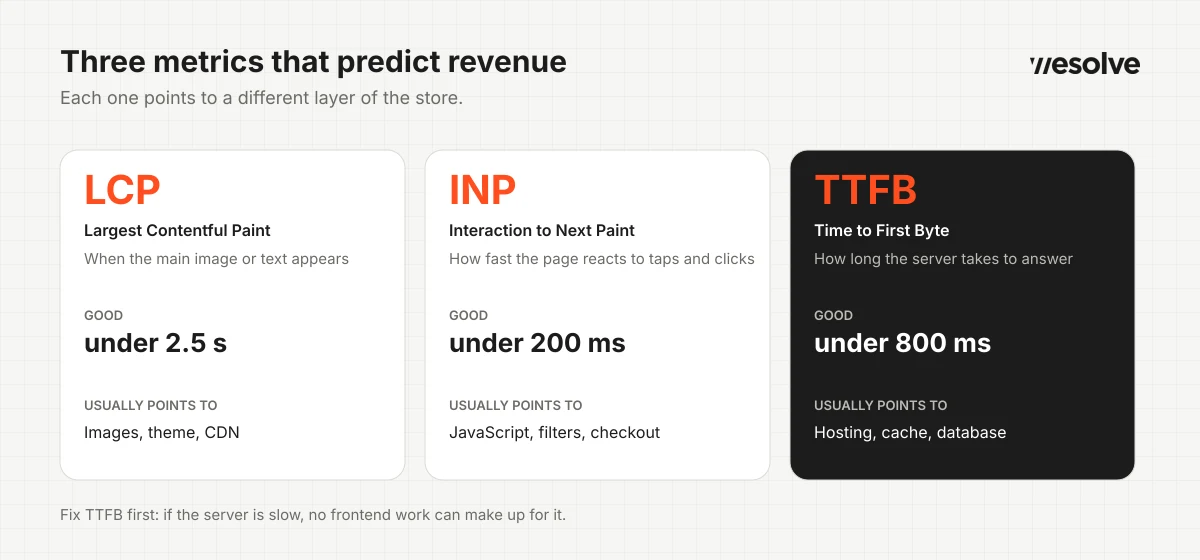
Largest Contentful Paint (LCP) measures when the biggest visible element (usually a hero or product image) appears. Good is under 2.5 seconds. Most unoptimised Magento stores on heavy themes sit well above that.
Interaction to Next Paint (INP) replaced First Input Delay in Core Web Vitals in March 2024. It measures responsiveness across the whole visit: filters, cart updates, checkout steps. Good is under 200 milliseconds. A store that loads fast but feels sluggish still loses people.
Time to First Byte (TTFB) is how long the browser waits for the server’s first byte. Above 800 milliseconds, the problem is almost always hosting or caching, not frontend code, and no frontend work will fully make up for it.
Speed also affects rankings
Google has used Core Web Vitals as ranking signals since 2021. A slow store converts worse and ranks lower, which means less traffic to convert in the first place. On competitive category keywords, that can be the difference between page one and page two, and the gap compounds.
Why stores stay slow
The causes split into two groups:
- Frontend: unoptimised images, render-blocking JavaScript, heavy third-party scripts, bloated themes, huge pages. Fixable in code. Hyvä removes most of them in one move.
- Infrastructure: undersized hosting, misconfigured full-page cache, no CDN, slow database queries, no autoscaling. Not fixable in code.
They interact: a perfect frontend on slow infrastructure still fails Core Web Vitals, and a fast server running a bloated theme fails too.
That’s why vendor setup matters. When the dev agency and the host are separate companies, problems that span both layers bounce between them while the store stays slow. One team that owns both can trace a slow TTFB to a misconfigured Redis cache and fix it in the same sprint. It’s the reason managed Magento hosting exists.
Fix in this order
- TTFB first. If the server is slow, everything after it is compromised. Check hosting, full-page cache and CDN before touching frontend code.
- LCP next. Find the largest element on your busiest pages, compress it, serve it as WebP and preload it.
- Third-party scripts. Defer or delay analytics tags, chat widgets and pixels.
- INP on interactive parts. Filters, cart drawers and checkout steps usually need JavaScript work or a frontend rebuild.
- Test on mobile. Scores differ, and that’s where most of your shoppers are.
For the Magento-specific fixes, see the six changes that move the needle.
Green scores are an architecture decision
Green Core Web Vitals on Magento don’t come from running PageSpeed and fixing what it flags. They come from the frontend framework (Hyvä vs Luma), the infrastructure (Varnish, Redis, autoscaling) and the deploy process. A store that’s green at launch and red six months later, after extension installs and theme tweaks, has a process problem. Test performance on every deploy, not just at launch.
Want to know what’s slowing your store down? Talk to an engineer at wesolve, or start with a technical audit.
FAQs
How much does a faster load time lift conversion? Deloitte found a 0.1-second mobile improvement lifted retail conversions by about 8%. The exact effect depends on your site and baseline, but the direction is consistent across studies.
Which Core Web Vitals metric matters most for ecommerce? LCP correlates most with perceived speed and conversion. TTFB sets a floor that frontend work can’t beat. INP matters most in filtering and checkout.
Why do Magento stores often score badly? The default Luma theme is heavy, and many stores run on hosting that isn’t tuned for Magento’s caching. Hyvä plus properly configured infrastructure addresses both.
How do I tell if my problem is frontend or infrastructure? Start with TTFB. Above 800ms, it’s mainly infrastructure. If TTFB is fast but LCP and INP are poor, it’s mainly frontend. Most stores have both.