

You scoped the project and got quotes. One agency says €30,000, another €120,000, and both promise four months. Neither explains what’s included or why the gap exists.
Here’s what actually happens in an Adobe Commerce implementation, what each phase needs in people and time, and where cost grows or gets controlled.
What you’re buying
Adobe Commerce isn’t a SaaS product you configure; it’s a platform you build on. Every implementation means architecture, custom modules, a theme, integrations, data migration and infrastructure. The scope differs between a new build, a replatform and an upgrade, but the phases are the same.
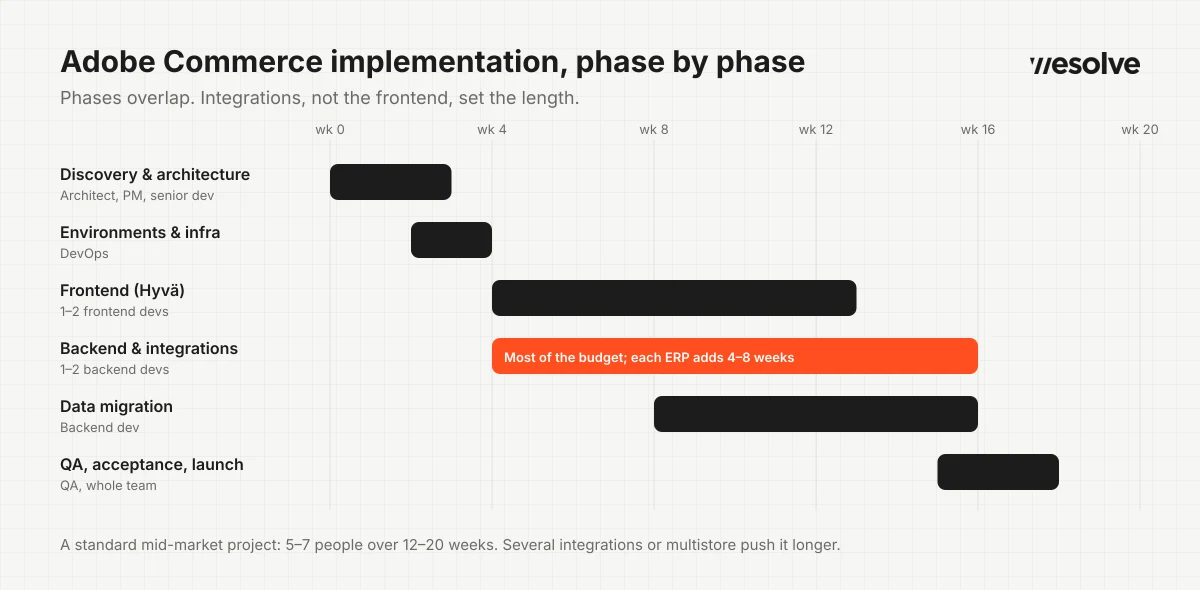
Phase 1: Discovery and architecture (2–4 weeks)
The phase buyers undervalue and agencies rush. It covers requirements, catalog structure, integrations (ERP, PIM, payments, logistics), performance targets and hosting. The output is a functional spec and an architecture document.
It needs a solution architect, a project manager and a senior backend developer. Compress it and you get rework, which is where timelines and budgets actually break. Cost grows with the number of integrations, catalog complexity and multistore or multilanguage needs.
Phase 2: Environments and infrastructure (1–2 weeks)
Development, staging and production environments, CI/CD pipelines, the base install and a hosting setup sized for your traffic. Runs alongside the start of development, led by a DevOps engineer.
If the agency builds the store but hands infrastructure to someone else, you’ve created a gap, and the gap is where incidents live. See managed Magento hosting.
Phase 3: Frontend (6–10 weeks)
The default Luma frontend works but is slow. In 2026, Hyvä is the standard choice for green Core Web Vitals without going headless (Hyvä or headless?).
A Hyvä build isn’t a template: custom components, checkout, category and product pages all need real engineering. Typically one or two frontend developers for six to ten weeks. Cost grows with custom design, the number of unique templates, checkout changes, and whether the team has shipped Hyvä before or is learning on your project.
Phase 4: Backend and integrations (the biggest line)
This is where most of the budget goes on complex projects. Custom modules, pricing rules, promotions, B2B and, above all, integrations:
- ERP (SAP, Microsoft Dynamics, SoftOne, Entersoft, custom systems)
- PIM (Akeneo, Pimcore or a bundled option)
- Payments (Stripe, Viva Wallet, PayPal, local acquirers)
- Logistics, CRM and marketing tools
Each one means mapping data, building connectors, handling errors and testing two-way sync. A single ERP integration can add four to eight weeks, depending on the ERP’s API and how complex order and stock flows are. A well-documented REST API integrates much faster than a legacy SOAP or file exchange. Patterns are in Magento ERP integration.
Where PIM, OMS, CIAM and DAM are all needed, CommerceSuite delivers them pre-connected on Magento, removing the connector work for each.
Phase 5: Data migration (alongside the build)
Products, categories, customers, orders and content all have to move cleanly. Magento’s migration tool rarely covers everything: custom attributes, third-party module data and order history usually need custom scripts.
Migration is often underscoped. Ask exactly what’s included and what the cutover plan is. Cost grows with SKU count, years of order history, source data quality, and whether you need zero downtime. See the replatforming checklist.
Phase 6: QA, acceptance and launch (2–3 weeks)
Functional, performance and security testing, then your team signs off the business-critical flows. This phase gets squeezed when earlier ones run long, and that’s a mistake: a checkout bug found after launch costs far more than one caught in staging. Launch means DNS cutover, SSL, cache warm-up and monitoring; on complex projects, a soft launch lowers risk.
Team size
A mid-market implementation typically needs:
- Solution architect: scope, architecture, integration design
- Project manager: timeline, stakeholders, risk
- 1–2 backend developers: modules, integrations, logic
- 1–2 frontend developers: Hyvä, checkout, performance
- DevOps engineer: environments, CI/CD, hosting
- QA engineer: functional, regression and performance tests
That’s five to seven people over 12 to 20 weeks for a standard project. Team size matters less for speed than for handoff risk: when backend, frontend and infrastructure belong to different vendors, bugs get blamed on the wrong layer and incidents bounce between them.
What really drives cost
- Integrations: more of them, more weeks; poor API documentation multiplies that
- Catalog and business logic: B2B pricing, configurables at scale, custom tax
- Frontend ambition: pixel-perfect custom design costs more than an adapted theme
- Agency structure: one that runs infrastructure too charges for both, but removes the coordination overhead and the post-launch blame loop
- Migration scope: often underquoted; get a separate line
- Post-launch: a quote that ends at go-live isn’t a complete quote
The gap after launch
Most quotes stop at go-live. Then security patches arrive, performance regressions appear under real traffic and integrations break when a third party changes its API. If the agency that built the store doesn’t also run it, you’re managing two vendors and two escalation paths.
wesolve works the other way: one team writes the code and runs the infrastructure, with 24/7 engineer monitoring, patching within release windows, and daily backups with one-click rollback. See how we work or book a call.
FAQs
How long does an implementation take? A standard mid-market project takes 12 to 20 weeks from discovery to launch. Several ERP integrations, multistore or a large migration push it longer.
What’s the biggest cost driver? Integrations. Each ERP, PIM, payment or logistics connection adds weeks, and API quality matters a lot.
What should an implementation quote include? A breakdown by phase, migration as its own line, and what happens after launch: hosting, patching and who responds to incidents.
Should the agency that builds the store also host it? There’s a strong operational case: one team knows the system end to end, so incidents are diagnosed faster and patches are applied by people who know the code.