

The wrong platform costs more than money. It costs developer hours, momentum and, often, a painful migration a few years later when you’ve outgrown it. In 2026 four platforms come up in most serious conversations: Magento (Open Source and Adobe Commerce), Shopify, BigCommerce and WooCommerce.
Each has a real use case. None is right for everyone.
What you’re really choosing
You’re not just picking a cart. You’re choosing a development model, a hosting arrangement, a cost structure and a ceiling on what your store can do.
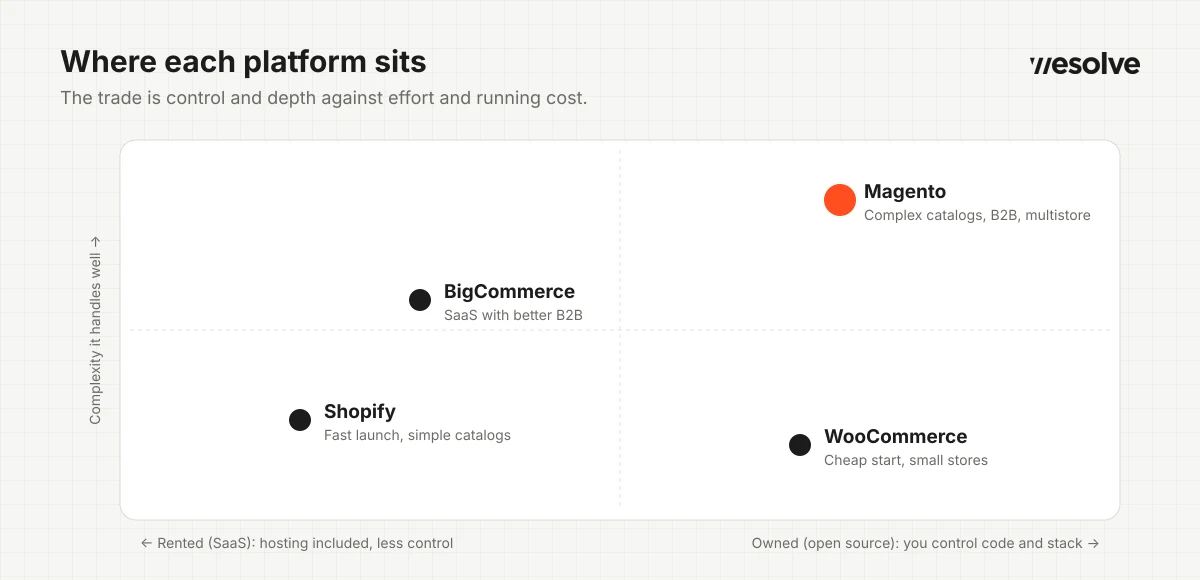
The four sit in two very different camps. Shopify and BigCommerce are SaaS: you rent the software and infrastructure together. Magento and WooCommerce are open source: you own the code and control the stack. Those relationships diverge more every year you run them.
Shopify
The easiest to launch on. Fast onboarding, a big theme ecosystem, no developer needed for a basic store.
The tradeoffs come with growth. Transaction fees apply unless you use Shopify Payments, which isn’t available everywhere. Deeper changes need Liquid and the API. Complex B2B, multi-warehouse stock or non-standard checkout often need workarounds or a pile of paid apps. Shopify Plus lifts some limits, at a price that starts to compete with a custom Magento build. More in Magento vs Shopify.
Best fit: small and mid-market direct-to-consumer brands with standard catalogs and little backend complexity.
BigCommerce
The SaaS option for merchants who’ve hit Shopify’s limits but don’t want to run open-source infrastructure. Stronger native B2B than Shopify, no transaction fees and a more flexible API.
Downsides: a smaller developer community, a thinner app ecosystem, and pricing tied to revenue thresholds that can jump as you grow.
Best fit: mid-market B2B or omnichannel merchants who want managed infrastructure with more built in than Shopify.
WooCommerce
A WordPress plugin, with WordPress’s strengths and limits. Cheap to start, a huge extension library, and natural for content-heavy businesses already on WordPress.
Problems show at scale. Its database design struggles with large catalogs and high order volumes without serious tuning. Performance, security hardening and plugin conflicts become ongoing work. More in Magento vs WooCommerce.
Best fit: small stores, content-first businesses and low-volume merchants already on WordPress.
Magento (Open Source and Adobe Commerce)
The most powerful platform here, and the most demanding. You own the code, control the infrastructure and face no artificial ceiling. Catalog management, pricing rules, multistore and native B2B go deeper than any SaaS option out of the box.
Adobe Commerce adds B2B modules, AI merchandising and enterprise support; Open Source gives you the core without a licence.
The catch: Magento needs a capable team. A badly configured instance is slow and expensive to run; a well-built one on the right infrastructure is fast, stable and scales cleanly. With Magento, the platform choice and the implementation-partner choice are the same decision.
Best fit: mid-market and enterprise merchants with complex catalogs, B2B, several stores or markets, or custom logic SaaS can’t handle.
Side by side
| Magento | Shopify | BigCommerce | WooCommerce | |
|---|---|---|---|---|
| Ownership | Full (open source) | Rented (SaaS) | Rented (SaaS) | Full (open source) |
| Hosting | You or your agency | Included | Included | You |
| Customisation | Very high | Moderate | Moderate | High, with effort |
| B2B | Native, deep | Limited | Good | Plugin-dependent |
| Multistore | Native | Limited | Limited | Difficult |
| Scalability | High, with proper infra | Medium | Medium | Low to medium |
| Cost at scale | Predictable | Grows with revenue and apps | Grows with revenue | Unpredictable |
| Developer need | High | Low to medium | Low to medium | Medium |
Total cost: what pricing pages don’t show
SaaS looks cheaper on day one; the maths changes over time. Shopify and BigCommerce bills grow with your revenue or plan tier, whether or not you use new features, and paid apps for things Magento does natively (advanced search, loyalty, complex promotions, PIM) add up fast.
Magento’s cost is front-loaded in build and infrastructure, with no per-transaction fees or revenue-based upgrades afterwards. For merchants doing meaningful volume, Magento often becomes the cheaper option within two to three years. The full breakdown is in Magento cost.
When Magento is the right call
- Complex attribute sets, configurable products or custom pricing
- Several stores across brands, regions or languages (multistore)
- B2B: company accounts, quotes, custom price lists
- You need to own your infrastructure for compliance, performance or cost
- You’re leaving a SaaS platform that became too expensive or too limiting
For these merchants the question isn’t really “Magento or Shopify?” It’s “who builds and runs the Magento store?” That’s the gap wesolve closes: the same team writes the code and runs the infrastructure, and where needed, CommerceSuite adds PIM, OMS, CIAM and DAM around Magento. See how we work.
Should you migrate?
Signals worth a look:
- Your monthly app bill exceeds what a Magento build would cost per year
- Customisation limits need ever more expensive workarounds
- Performance has dropped as catalog or traffic grew
- Your vendor’s pricing changed in ways that no longer fit
Migration is disruptive; staying on the wrong platform is a slower kind of disruption. Start with the replatforming checklist.
FAQs
Which platform handles large catalogs best? Magento. Its attribute management, configurable products and layered navigation are built for scale; the SaaS options need more workarounds as complexity grows.
Is Shopify good for B2B? For simple B2B, especially on Plus, it can work. For company hierarchies, custom price lists, quotes and approvals, Magento’s native B2B is much more capable.
Can WooCommerce scale to enterprise? With heavy engineering, partly. It isn’t built for enterprise volume or complexity, and most merchants with real enterprise needs eventually move.
Open Source or Adobe Commerce? Open Source suits most mid-market merchants. Adobe Commerce makes sense when you need its B2B modules, AI merchandising or enterprise support.