

Ask what Magento costs and you’ll get a range so wide it’s useless: “anywhere from €5,000 to €500,000”. The useful question isn’t what Magento costs in the abstract. It’s what you’re actually paying for, and whether you’re getting it.
First: which Magento?
Magento Open Source has no licence fee. But free to download isn’t free to run: every euro goes into development, hosting and maintenance.
Adobe Commerce adds a licence that scales with gross merchandise volume, typically tens of thousands of euros a year for mid-market retailers, plus B2B features, a cloud option and Adobe support. Full detail in Adobe Commerce pricing.
Most mid-market retailers in Greece and Southeast Europe run Open Source. The licence cost is zero. The running cost isn’t.
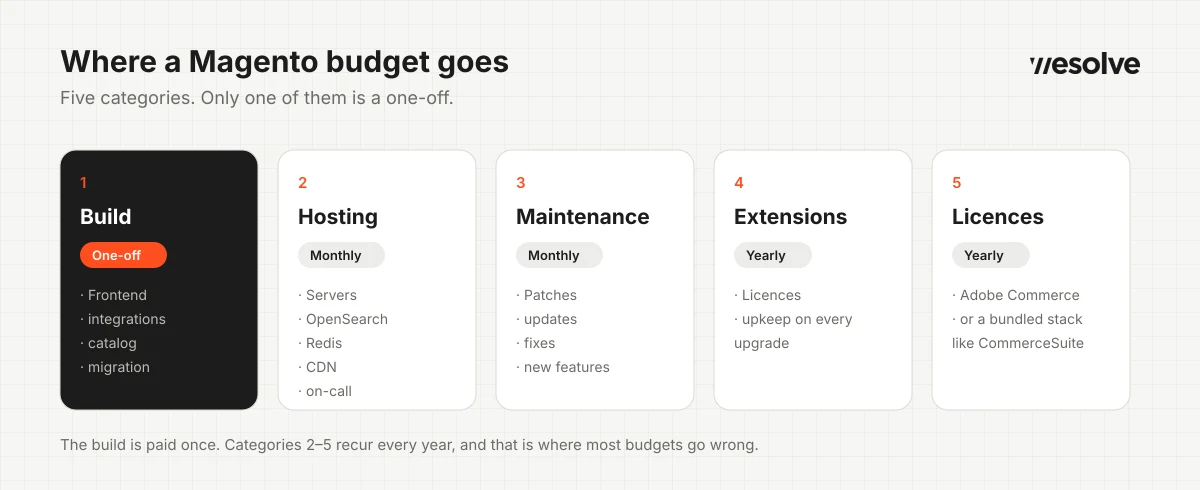
The five cost categories
1. Build
Usually the biggest upfront cost. A specialist build runs from roughly €30,000 for a focused store to €100,000+ for custom checkout logic, ERP integration and a Hyvä frontend. What pushes it up:
- Frontend: Hyvä costs more than Luma to build, but delivers far better Core Web Vitals. If your mobile PageSpeed is in the 40s, that gap is costing you conversions.
- Integrations: ERP, PIM and payment connections each need scoping, building and testing. Budget per integration, not as one line.
- Catalog complexity: 500 simple SKUs is a different project from 50,000 with configurables, bundles and multiple warehouses.
- Replatform vs new build: migration adds data transfer, URL mapping and SEO continuity work. See the replatforming checklist.
2. Hosting and infrastructure
This is where hidden costs live. Magento can’t run on shared hosting. It needs dedicated or cloud servers, a tuned PHP setup, OpenSearch, Redis and a CDN.
A bare self-managed VPS might cost a few hundred euros a month. A properly configured, autoscaling setup with monitoring, patching and daily backups costs more, and that’s the price of not going down on Black Friday. Ask every host: who responds at 2am? If the answer is a ticket queue, you have an accountability gap. See managed Magento hosting.
3. Ongoing development and maintenance
A Magento store isn’t a project you finish; it’s a platform you run. Security patches, extension updates, broken integrations, new features. Two models:
- Retainer: fixed monthly hours for development, maintenance and support. Predictable cost and access.
- Time and materials: billed as needed. Cheaper baseline, slower when something urgent happens.
For a store with real revenue, a retainer is almost always better: one delayed fix during peak season costs more than the retainer. See what a retainer should cover.
4. Extensions
Paid modules run from a few hundred to several thousand euros a year. The hidden cost isn’t the licence; it’s the maintenance. Each extension adds conflicts, security exposure and upgrade friction. A good agency pushes back on extension sprawl and builds custom where that’s cheaper long-term.
5. Bundled platform licensing
If you need PIM, OMS, CIAM or DAM, some agencies offer them pre-integrated. wesolve’s CommerceSuite provides all four around Magento, replacing several vendor contracts. Compare the bundle’s cost with separate PIM and OMS licences plus the integration work to connect them. See CommerceSuite.
Where costs get out of control
The most expensive setups aren’t the ones with the highest quote. They’re the ones with the wrong agency, the wrong host and nobody owning the outcome.
- Split vendors. Dev agency, host and support contract: incidents fall between them while your store is down.
- Undersized infrastructure. Slow pages, failed cron jobs and outages under load. A Black Friday outage almost always costs more than proper infrastructure would have.
- Cheap builds. A €10,000 build is usually Luma, extension-heavy and untuned. Rebuilding it 18 months later, plus the revenue lost meanwhile, usually exceeds the cost of doing it right.
- Nobody owns uptime. If your vendor can’t tell you their measured uptime, that’s a signal.
What a well-run engagement costs
For a mid-to-large retailer, development, hosting and maintenance together typically fall between €30,000 and €120,000 a year, depending on complexity, integrations and how much new work you do. It should include:
- Development by certified Magento engineers
- Hosting built for Magento, with 24/7 engineer response
- Security patching within release windows
- Daily backups and rollback
- Ongoing maintenance and feature work
What it shouldn’t include: three vendor contracts and a gap when something breaks.
Open Source or Adobe Commerce?
Adobe Commerce makes sense if you need native B2B (company accounts, negotiated pricing, requisition lists), Adobe’s support, or you’re already in Adobe Experience Cloud. Open Source fits most mid-market retailers: same core code, no licence. A good agency answers this by your requirements, not by which option makes a bigger project.
The real question
Not “how much does Magento cost?” but what does it cost to run it badly, and what does it cost to run it well? Badly costs you outages, slow pages, lost conversions and rebuilds. Well costs more upfront and doesn’t surprise you.
Planning a build or reviewing your current setup? Book a discovery call with wesolve.
FAQs
What does Magento Open Source cost to run per year? The licence is free. Development, hosting and maintenance for a mid-market retailer typically total €30,000–€120,000 a year, depending on complexity and ongoing work.
Why do Magento quotes vary so much? Frontend (Hyvä vs Luma), catalog complexity, integrations, new build vs migration, and how specialised the agency is. A €10,000 and an €80,000 quote usually describe different work, not the same work at different margins.
Is managed Magento hosting worth it? For any store with meaningful revenue, yes. An outage in peak season almost always costs more than proper hosting.
What hidden costs should I watch for? Extension licences and upkeep, under-scoped integrations, infrastructure upgrades as traffic grows, and emergency work caused by split vendors.
How much does Hyvä add? It costs more to build than Luma, but delivers much better Core Web Vitals, which pay back through conversion and search rankings.