

Most complex Magento projects take longer than they should. Not because the platform is hard to configure, but because the systems around it come from different vendors. Product data lives in one tool, orders are routed by another, customer identity sits in a third and images in a fourth. Every connection between them is custom work, and launch day waits for the slowest one.
CommerceSuite is how we solved that for the projects that need those systems.
What CommerceSuite is
CommerceSuite is wesolve’s infrastructure of business systems around Magento. It provides four capabilities that retailers usually buy and integrate separately:
- PIM: product information management
- OMS: order management
- CIAM: customer identity and access management
- DAM: digital asset management
It’s used where a project actually needs them: large or multi-language catalogs, complex fulfilment, B2B identity, big asset libraries. A straightforward store doesn’t need it, and most of our Magento projects run without it.
When those four systems arrive already connected to Magento, the integration work that normally eats months of a launch is already done. You’re not waiting on an API handshake between a product-data vendor and an order system, or debugging mismatches between them. The connections are built in.
Where launch time actually goes
A typical complex launch with separately sourced systems looks roughly like this:
| Weeks | What happens |
|---|---|
| 1–4 | Scoping sessions with three or four vendors, each with a different picture of the project |
| 5–12 | Integration work between systems never designed to talk to each other |
| 13–18 | Staging problems where the integrations behave differently from production |
| 19–24 | Bug triage where each vendor points at another’s system |
That’s six months for a project that could take six to ten weeks. The delay isn’t the platform; it’s the integration layer and the number of parties involved.
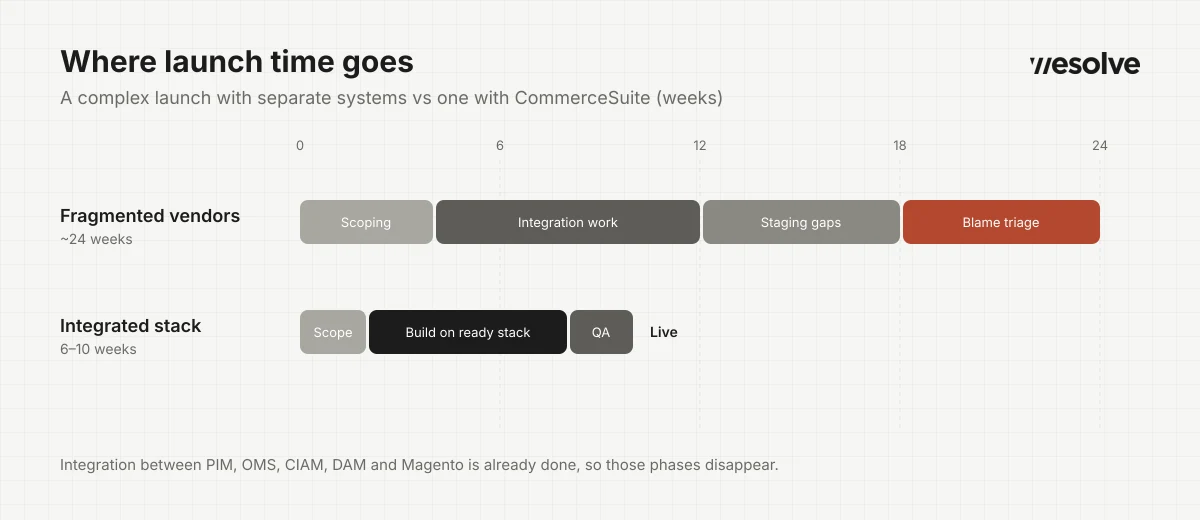
CommerceSuite removes that integration layer: PIM, OMS, CIAM and DAM are already wired into Magento, so the project starts from systems that work together.
What changes, system by system
PIM. Product data is usually the first bottleneck: catalogs live in spreadsheets, ERPs or legacy systems. With a separate PIM vendor, you spend weeks on mapping, API setup and testing. In CommerceSuite the import pipelines are built for Magento’s data model, so you start filling the catalog on day one. More in PIM for ecommerce.
OMS. Order management is where fragmented setups break most visibly: a separate integration, separate webhooks, separate failure modes. When an order fails to sync, nobody knows which system caused it. With CommerceSuite, order state stays consistent across storefront, fulfilment and reporting. More in order management.
DAM. Images, video and brand files usually live outside the commerce stack, causing version problems and making merchandisers wait for developers. CommerceSuite’s DAM connects directly to the catalog, so asset updates go live without a deployment.
CIAM. Identity sits under login, accounts, B2B buyer permissions and loyalty. Bolted on from a third party, every feature that touches identity needs another integration. With CommerceSuite, identity works the same way across storefront and back office.
CommerceSuite or your own composable stack?
Some retailers assemble their own: Magento, a third-party PIM, a third-party OMS and a DAM from yet another vendor. The appeal is flexibility. The reality is an integration tax that never stops: every connection is custom code to build, test and maintain, and every vendor API change is a breaking change you absorb.
CommerceSuite gives you those composable components already integrated with Magento and with each other. If you already run one of these systems (an Akeneo PIM, say) and it works, you can keep it; we connect what you have. See PIM integration for Magento and composable commerce.
Hosting is a separate choice
CommerceSuite doesn’t depend on where your store is hosted. wesolve also offers managed Magento hosting, run by the engineers who build the stores, and you can use either one without the other. See managed Magento hosting for that side.
Wondering whether your project needs it? Talk to an engineer at wesolve.
FAQs
What is CommerceSuite? wesolve’s PIM, OMS, CIAM and DAM infrastructure around Magento, already connected to it and to each other. It’s used on projects that need those systems.
Does every Magento project need it? No. Simple stores run fine on Magento alone. It earns its place with complex catalogs, fulfilment, B2B identity or large asset libraries.
How does it reduce launch time? The integration work between these systems and Magento, which usually fills most of a complex launch, is already done.
Does it work with Magento Open Source and Adobe Commerce? Yes, both.
Is it tied to wesolve hosting? No. CommerceSuite and wesolve’s managed hosting are independent.
Can I add it to an existing Magento store? Yes. It can be introduced into an existing store, and existing systems you want to keep can be connected instead.