

Your Shopify store runs fine. Orders come in, checkout works, the team knows the admin. But “fine” has a ceiling: transaction fees that grow with volume, customisation limits that block your roadmap, catalog structures that can’t hold your real complexity.
Moving to Magento isn’t right for every merchant. When the conditions are right, though, the financial case isn’t close.
The Shopify costs you stop noticing
Shopify’s pricing feels predictable until you do the maths at volume.
- Transaction fees. Unless you use Shopify Payments, every order carries an extra fee (higher on lower plans). Where Shopify Payments isn’t available, or you work with local acquirers, it doesn’t go away. At €2 million GMV, even 0.5% is €10,000 a year for nothing operational.
- The app stack. Mid-market Shopify stores often run 15–25 paid apps for things Magento does natively or through custom code: advanced filters, B2B pricing, multi-warehouse stock, custom checkout, loyalty. At €30–300 a month each, that’s €5,000–50,000 a year, and none of it is yours. Each app is a dependency that can raise prices, shut down or slow your pages.
- The plan fee. Shopify Plus starts at around USD 2,300 a month.
None of this is a criticism of Shopify. It’s a well-built platform for the merchants it was designed for. The problem is outgrowing the model it was built around.
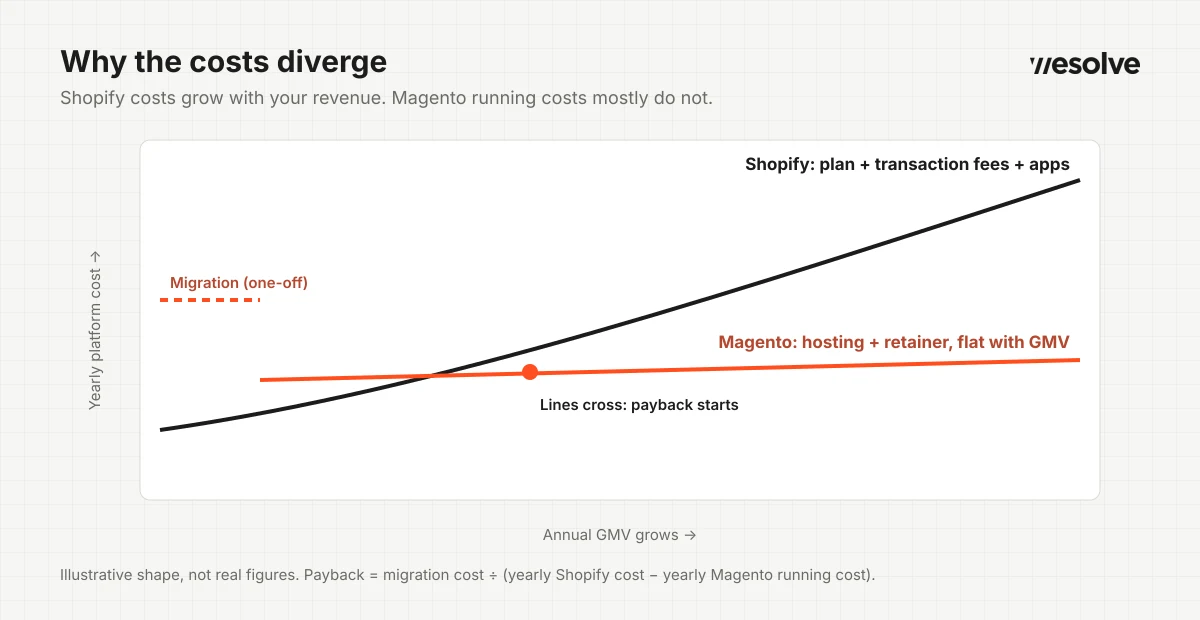
What Magento changes
Magento Open Source has no licence fee. You pay for development, hosting and maintenance, not per transaction, per app or per plan tier. As GMV grows, the platform cost doesn’t grow with it.
You also own the code: checkout logic, pricing rules, catalog structure and B2B hierarchy all live in your repository, not in configuration on a platform you rent. That matters for multistore with shared catalogs, real-time ERP sync and B2B with customer prices, credit limits and approvals. See the platform comparison.
Three signs the switch pays
- Transaction fees are a real line item. If they exceed €8,000–10,000 a year, you’re funding a migration with money you currently give away.
- Your app stack is expensive and fragile. Over €1,500 a month and still hitting walls? The apps aren’t solving the problem; they’re papering over a platform mismatch.
- Your roadmap is blocked. Features you can’t build because the platform won’t allow them have a cost: revenue not earned, B2B accounts not onboarded.
When all three are true, the question isn’t whether the migration pays back, but how fast.
What a migration costs
- Straightforward (under 10,000 SKUs, standard checkout, no complex B2B, clean export): roughly €20,000–50,000 in development.
- Complex (multistore, ERP integration, custom pricing, Hyvä frontend): roughly €60,000–150,000.
Payback = migration cost ÷ (annual Shopify cost − annual Magento running cost). Shopify cost means plan fee plus transaction fees plus apps; Magento running cost means hosting plus a maintenance retainer. For merchants at meaningful GMV, payback is often under two years. The full cost picture is in Magento cost.
What most merchants underestimate is the cost of a bad migration: a store launched broken or slower than before means months of lost revenue and doing it all again.
The data migration
Shopify exports are clean and Magento’s import tools are mature. The complexity is in the details:
- Order history, and product attributes that don’t map cleanly
- Shopify metafields become Magento custom attributes
- Saved payment cards can’t be migrated; customers re-enter them
- URLs change, so every one needs a 301 redirect
The redirect map deserves its own workstream. Every URL that changes without a redirect throws away ranking you already earned. The full process is in the replatforming checklist.
When it doesn’t make sense
- GMV under about €500,000 with a simple catalog. Shopify is probably right; Magento’s overhead pays off at scale.
- Straightforward direct-to-consumer: standard checkout, no B2B, one store. Shopify’s limits may never bind you.
- No budget for a proper migration and ongoing upkeep. A half-built Magento store is worse than a fully working Shopify one.
After launch: infrastructure becomes yours
On Shopify, infrastructure isn’t your problem. On Magento it is, unless your agency owns it. An agency that builds the store and hands it to a generic host leaves you with two vendors and nobody accountable when it breaks at 2am on Black Friday.
At wesolve, the engineers who write the store code run its infrastructure: 24/7 engineer monitoring, patching within release windows, daily backups and one-click rollback. For merchants leaving Shopify, that’s what makes the move manageable: you swap a platform you rent for one you own, with a team that keeps it running. More in managed Magento hosting.
For complex catalogs or order logic, CommerceSuite adds PIM, OMS, CIAM and DAM on Magento, so you don’t start from zero.
Choosing a partner
- Have they done Shopify to Magento specifically?
- Do they run hosting, or hand it off after launch?
- Who’s accountable when something breaks after launch?
- Can they show live stores they built and still run?
The last question tells you most. See how we work, or work through your numbers with us.
FAQs
When does the switch make financial sense? When plan fees, transaction fees and apps cost enough that the migration pays back within a reasonable time, typically under two years.
How long does it take? A clean catalog with standard checkout: 8–16 weeks. ERP integration, multistore, B2B pricing or a Hyvä build take longer.
Will I lose rankings? Not if every changed URL has a 301 redirect before launch.
Open Source or Adobe Commerce? For most mid-market merchants leaving Shopify, Open Source is enough. Adobe Commerce makes sense for advanced B2B or Adobe’s cloud.
Is Magento harder to run than Shopify? It needs patching, upgrades and infrastructure management that Shopify handles for you. The right managed hosting closes that gap.