

Product data is rarely the problem anyone plans for. You go live with 4,000 SKUs, then discover descriptions are inconsistent, attribute sets don’t match the ERP’s output, and someone updates 600 products by hand every time a supplier sends a price sheet.
That’s when the PIM conversation starts, usually with three questions: Akeneo or Pimcore? Connector or custom integration? And what does the integration actually involve? If you’re still deciding whether you need a PIM at all, start with PIM for ecommerce.
Akeneo: the common default
Akeneo is the most requested PIM in mid-market Magento projects: a clean data model, strong multi-language support and an official connector.
The official Akeneo Connector for Magento 2 handles:
- Products and product models
- Attributes, and families mapped to attribute sets
- Category trees
- Configurable and simple products
- Filtering by locale and channel
For a standard catalog, that covers most of it.
Where it breaks. The connector assumes Akeneo’s model and your Magento catalog roughly align. When they don’t:
- Attribute types Magento has but Akeneo doesn’t map natively, like visual swatches
- Configurables with more than two variation axes, where default logic creates duplicate or orphaned simples
- Multi-website Magento with different prices, tax or visibility per store view
- ERP pricing that flows through Akeneo first: a three-system sync, not two
- Images held in a separate DAM that must be resolved before import
None of these are unsolvable, but they need custom mapping, event-driven sync or middleware, not just connector settings.
Pimcore: a wider platform
Pimcore combines PIM, DAM and CMS in one open-source platform. For merchants who want to consolidate systems, that’s genuinely useful. For merchants who just need clean product data in Magento, it can be more architecture than the problem needs.
It fits when:
- You want assets and product data in the same system
- You’re building a headless or composable setup with Pimcore as the content layer (composable commerce)
- You have developers to maintain a self-hosted platform
There’s no official Magento connector with Akeneo’s adoption. Most integrations use Pimcore’s DataHub or a custom API bridge, with development on both sides.
When a custom connector beats both
Your ERP is already the master. If SAP, Dynamics or your own system already holds clean product data with an established workflow, a PIM means copying data into another system and maintaining two sources of truth. A direct ERP-to-Magento connector is often simpler and cheaper. Patterns are in Magento ERP integration.
Your catalog is stable. 500 SKUs that change twice a year rarely justify a PIM’s implementation and licence.
Your data model is unusual. Made-to-order configurables, dynamic pricing or deep attribute hierarchies sometimes need logic in code, not configuration. A custom connector lets you write it once, test it against real data and own it.
Side by side
| Akeneo | Pimcore | Custom connector | |
|---|---|---|---|
| Best for | Multi-language catalogs, established content workflows | Headless or composable, PIM plus DAM | ERP as master, stable or unusual catalog |
| Official Magento connector | Yes | No; custom build | Not applicable |
| Setup effort | Medium | High | Medium to high |
| Ongoing upkeep | Low to medium | Medium to high | Low, if well built |
| Multi-channel publishing | Strong | Strong | Magento only, unless extended |
| UI for non-technical staff | Strong | Strong | Depends on the build |
| Licence | Free community edition; paid SaaS tiers | Self-hosted, community and commercial editions | None |
Four questions that decide it
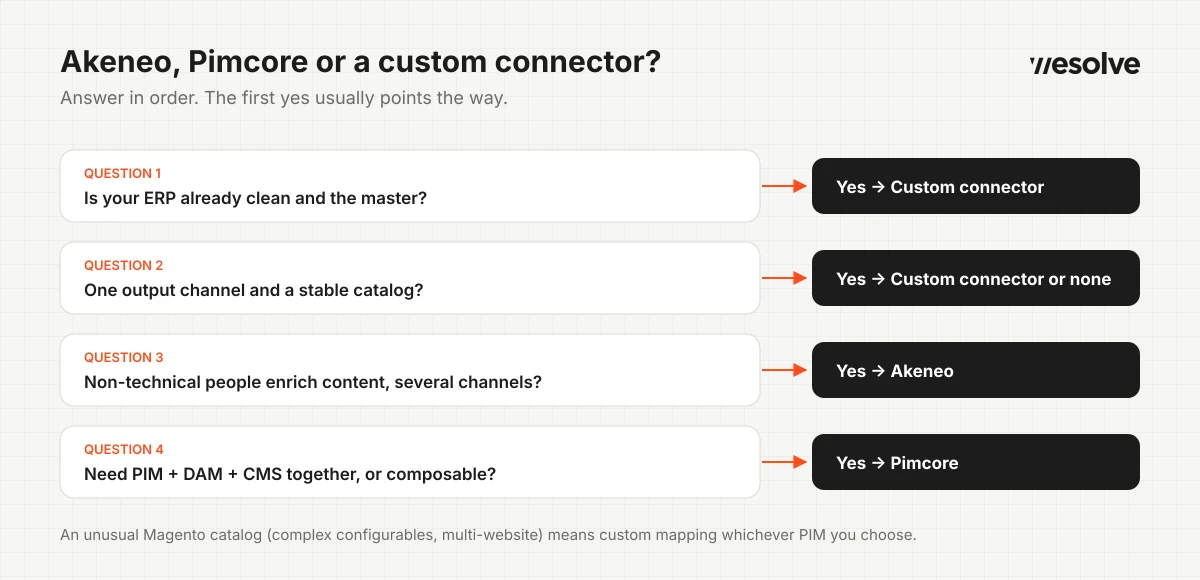
- Where does product data originate? If it’s the ERP, does a PIM sit between ERP and Magento, or is the ERP the record and Magento the only output?
- How many output channels? A PIM pays back fastest when the same data goes to the store, marketplaces, a B2B portal and print. One channel changes the maths.
- Who enriches the content? Non-technical people writing descriptions and translations make a PIM’s interface worth a lot. A developer running imports may be better served by a connector.
- How unusual is your Magento catalog? Complex configurables, multi-website and custom attribute types mean custom mapping, whichever PIM you pick.
Where CommerceSuite fits
CommerceSuite, wesolve’s stack on Magento, includes PIM alongside OMS, CIAM and DAM, with a data model designed for Magento from the start rather than mapped onto it. Merchants with an established Akeneo setup can keep it; the integration layer handles the sync. For merchants starting fresh, it removes the most common source of integration trouble: the gap between how a PIM models products and how Magento expects them. See CommerceSuite.
Before you start
- Clean the data first. A PIM doesn’t fix bad data; inconsistent values, missing fields and duplicate SKUs follow you in.
- Decide sync direction. Most run PIM → Magento. Two-way sync is much harder to build and maintain. Confirm before scoping.
- Test on production-like staging with a representative slice of the whole catalog. The edge cases are always in the long tail.
- Watch versions. Magento upgrades can break connectors; check compatibility before upgrading. For custom connectors, make sure your team owns the code.
- Schedule big syncs off-peak and use queues for large catalogs, so imports don’t slow the storefront.
A connector nobody owns is a connector that breaks silently. At wesolve, the team that builds the integration also runs the store and its infrastructure. Talk to us about yours.
FAQs
What does a Magento Akeneo integration do? It syncs product data, attributes, categories and translations from Akeneo into Magento automatically, using the official connector plus custom work for unusual catalogs.
Akeneo or Pimcore? Akeneo is the faster path to clean product data with an official connector. Pimcore suits composable setups that want PIM, DAM and CMS in one platform.
How long does an integration take? A standard Akeneo integration with simple mapping and one store view: about four to eight weeks including testing. Custom connectors, multi-website or ERP involvement take longer.
What happens when Magento is upgraded? Connectors can break. Check compatibility and test on staging before every upgrade.