

Composable commerce comes up at every conference and on every vendor roadmap, and is misunderstood by almost everyone who has to act on it. If you run Magento, you’ve probably wondered whether it applies to you, whether it means replatforming, or whether it’s marketing dressed as architecture.
It’s a real architectural direction. But the version sold to mid-market retailers is often more complicated than it needs to be.
What it actually means
Composable commerce splits the platform into separate services connected by APIs: storefront, product data, orders, identity and payments, each replaceable on its own. The MACH label (Microservices, API-first, Cloud-native, Headless) describes the model.
The promise is flexibility: change search without rebuilding checkout, update the storefront without touching the OMS, scale the catalog separately from sessions. That flexibility is real. So is its cost.
Where Magento fits
Magento’s core is a monolith, and that’s not a criticism. It’s why Magento is reliable, extensible through modules and understood by a large engineering community.
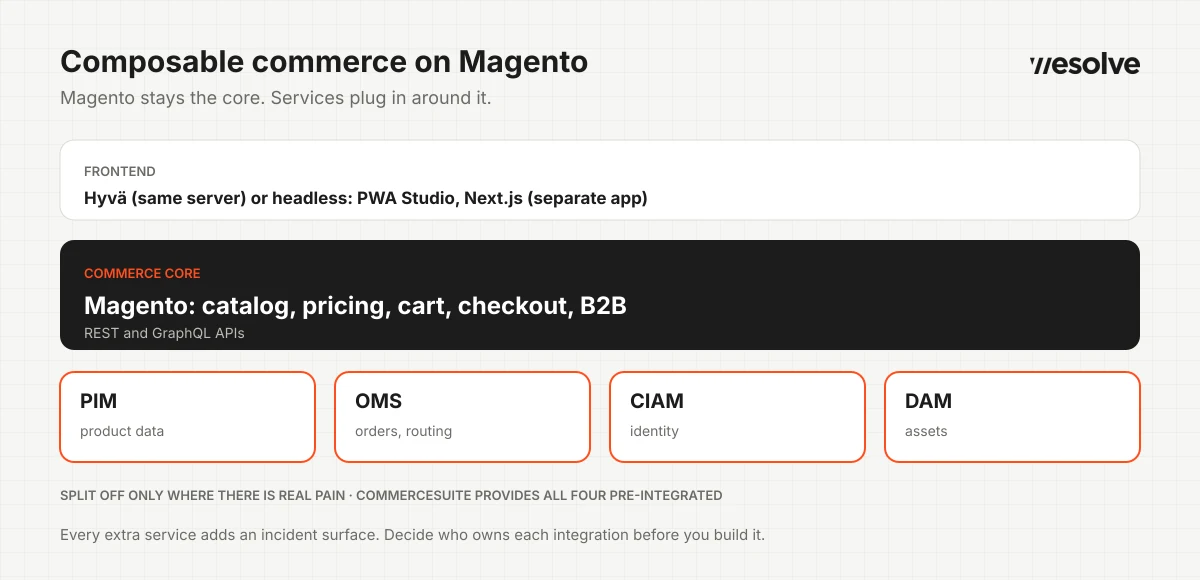
What’s changed is everything around it: Magento now exposes its functions through APIs. So for Magento, composable means keeping Magento as the commerce core and splitting off only the layers where your needs outgrow it, not rebuilding everything on a MACH platform.
The frontend
The most common move. A headless frontend (React or Vue, often via PWA Studio or Next.js) reads Magento’s GraphQL API and renders the store. It adds a second deployment and needs API versioning discipline.
Hyvä is worth separating out: it isn’t headless. It replaces Luma with a lightweight Alpine.js and Tailwind theme on the same server: an independently maintainable frontend without a second app to run. For most mid-market merchants, Hyvä gives most of the benefit with none of the extra operations. See Hyvä or headless?
The services layer
- PIM: when the catalog is large or managed by people who shouldn’t need Magento admin. (PIM integration)
- OMS: when several warehouses, routing rules or 3PLs outgrow native order handling. (Order management)
- CIAM: for loyalty, B2B account hierarchies or one identity across brands.
- DAM: when thousands of assets need versioning, rights and delivery.
Who should care
Engineering. API contracts, versioning and more failure points, in exchange for frontend and backend teams working independently. The real question isn’t “should we go composable?” but “which layer actually hurts?” A slow frontend calls for Hyvä or headless; messy product data calls for a PIM. Split where there’s a real problem, not everywhere at once.
Infrastructure and operations. One Magento app becomes Magento plus a frontend plus a PIM plus an OMS plus a CDN. Each has its own incident surface, and at 2am on a peak day, working out which service broke and who fixes it gets hard when different vendors own each layer. This is the part vendor pitches skip.
Product and commercial. Faster iteration on the layers you decouple: designers ship without waiting on backend releases, merchandisers manage data without Magento admin. The risk is scope creep: a frontend project turns into a full decomposition. Define what you’re decoupling and why before engineering starts.
The cost nobody advertises
Composable isn’t automatically better than a well-run monolith; it’s a trade-off. You gain flexibility and independent scaling; you give up simplicity and operational coherence.
A store with a few thousand SKUs, one warehouse and a small team will get more from well-configured Magento, Hyvä, clean ERP integration and good managed hosting than from a loosely integrated composable stack. A merchant with a complex catalog, several warehouses, cross-border trade and teams with distinct ownership solves real coordination problems with it.
Most mid-market merchants sit in between, so let the specific pain points decide, not the fashionable philosophy.
Our approach: CommerceSuite
We built CommerceSuite for the space between bare Magento and a fully decomposed stack, for projects that need it. It provides PIM, OMS, CIAM and DAM pre-integrated on Magento, so the integration work between them is already done. That’s what shortens complex projects.
We’re not rebuilding Magento as microservices. We’re making the services mid-to-large merchants actually need available as one tested layer, already connected to Magento. For any composable plan, ask: who owns the integrations between services, and who’s accountable when one breaks? That gap is where most composable projects get into trouble. See CommerceSuite.
Signs it’s worth doing
- Product data suffers because the people managing it fight Magento admin
- Fulfilment logic needs heavy customisation for routing, returns or multi-warehouse allocation
- Frontend work is blocked by backend releases, and you can maintain a decoupled frontend properly
- Identity across brands or regions goes beyond Magento’s customer model
- You’re replatforming anyway, so designing for it from the start is justified
None of these needs a full MACH rebuild. Each points to one layer.
Claims to treat with scepticism
- “Composable is always faster to iterate.” Only on the layers you decoupled. A neglected headless frontend out of sync with the API is slower than a Hyvä theme.
- “You can swap any part any time.” Replacing a PIM or OMS after two years in production means migration, API changes and lots of testing. Easier than replacing a monolith, not trivial.
- “Composable means you don’t need Magento.” Magento remains one of the most capable commerce engines, especially for deep catalogs, complex pricing and B2B.
Wondering where composable fits for you? Talk to us, or see how we work.
FAQs
What is composable commerce on Magento? Keeping Magento as the commerce core and connecting separate services (frontend, PIM, OMS, identity, assets) through APIs where native features fall short.
Does it mean replacing Magento? No. The common patterns add services around Magento.
Headless vs composable? Headless means splitting off the frontend. Composable is broader and includes splitting PIM, OMS, CIAM and DAM.
Is Hyvä composable? Not in the headless sense: it runs on the same server. It delivers most of the performance and maintainability gains without the extra operations.