

You have thousands of SKUs, a warehouse in Attica and customers who expect fast delivery and a clean checkout. You’ve been told Magento is the right platform. Here’s what building a Greek eshop on Magento Open Source actually involves: the architecture choices, the Greek-market details you can’t skip, and what happens after launch.
Why Greek retailers still choose Magento
Magento Open Source isn’t the easiest place to start: it needs real infrastructure, development and upkeep. Greek mid-market retailers choose it because the alternatives hit a ceiling. Hosted platforms work for small, simple catalogs, but complex pricing, several warehouses, ERP sync or a B2B portal next to the B2C store mean fighting the platform instead of building on it.
Magento has no such ceiling: you can extend every layer, and you own the infrastructure and the data. See the platform comparison.
Three architecture decisions
Version. Start on the current 2.4.x line. Don’t inherit a 2.3 codebase if you can avoid it: the upgrade effort and security exposure grow the longer you wait. Every custom module is a dependency you’ll carry across versions, so keep extensions few and custom code documented.
Frontend. Luma on mobile typically scores in the 40s and 50s on PageSpeed. With most Greek sessions on mobile, that’s a conversion problem before launch. Hyvä (Alpine.js and Tailwind instead of Knockout and RequireJS) is far faster. For a new build in 2026, use Hyvä.
Hosting. This is where most Greek Magento builds go wrong. Magento needs autoscaling, Varnish, Redis, a CDN and someone who knows what your server does at 11pm on a campaign day. The question isn’t whether to use managed hosting but who manages it.
The Greek-market details
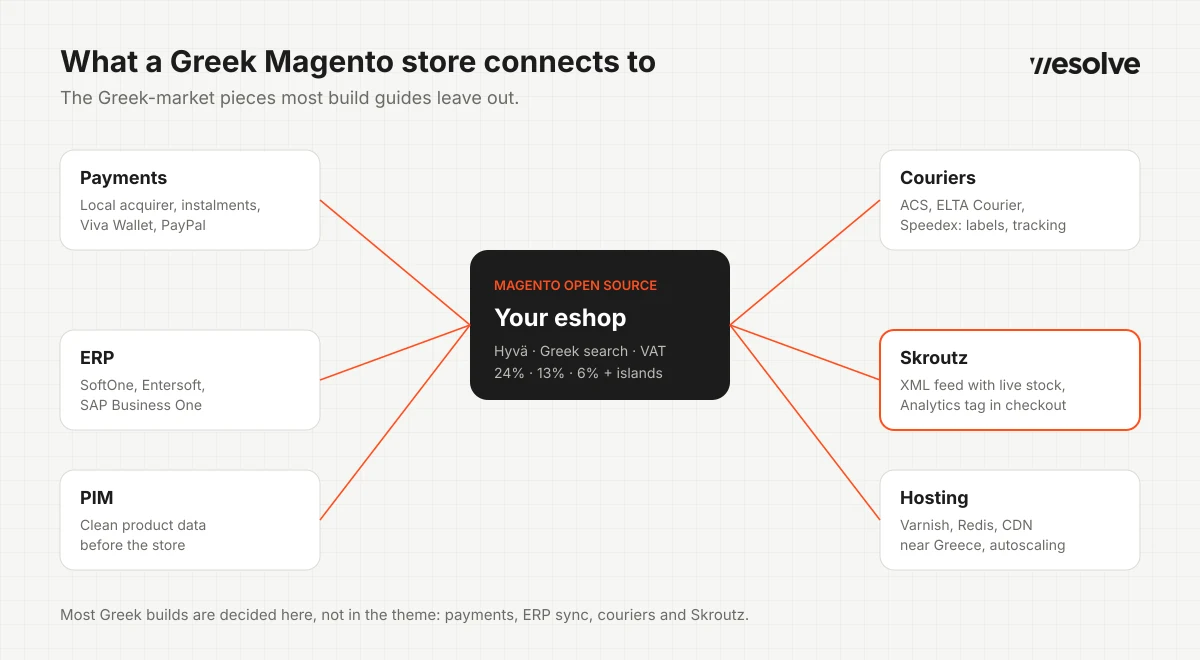
Payments and instalments
Cards through a local acquirer (Eurobank, Alpha Bank, Piraeus, National Bank) are the baseline. Instalments (δόσεις) are a significant conversion driver in Greece and must work from day one. Viva Wallet is widely used, and PayPal matters for cross-border orders. Bank onboarding in Greece isn’t fast: start it early.
VAT
24% standard, 13% reduced and 6% super-reduced, plus reduced rates on certain Aegean islands. Magento handles all of this, but it has to be configured correctly for your catalog: an error is a compliance problem, not a display bug.
Greek language and search
UTF-8 means Greek characters aren’t a technical problem. The issues are URLs and search:
- Magento transliterates Greek in URL keys. Decide your URL strategy before loading the catalog; changing it later means redirects.
- Greek is highly inflected. “παπούτσια” and “παπούτσι” should return the same results, and out of the box they may not. Search needs tuning for Greek.
Couriers
Customers expect ACS, ELTA Courier, Speedex and others. Integrations vary in quality: some are community modules with patchy maintenance, others need custom work for labels, tracking and returns.
Skroutz
Skroutz is the dominant Greek price comparison and marketplace platform. For most Greek B2C retailers, a correct XML feed with accurate category mapping and live stock isn’t optional. The Skroutz Analytics tag also needs custom work in the checkout: a small job, but easy to miss if your agency hasn’t built for Greece before.
Catalog architecture
- Define attribute sets before importing. Group them by product family, and avoid one universal set with 200 attributes.
- Plan configurable products (size, colour) carefully: they create heavy database load at scale if not indexed properly.
- Build categories around how customers search, not how the warehouse or shop floor is laid out. Use layered navigation for the filters that matter.
ERP and PIM
Most Greek mid-market retailers run SoftOne, Entersoft or SAP Business One. Syncing catalog, stock and orders with the ERP is the difference between running an eshop and running a data-entry operation. A proper integration covers:
- Products, prices and promotions
- Near-real-time stock
- Orders to the ERP for fulfilment
- Returns and credit notes
Direct database-to-database sync is fragile; an API with a message queue is more resilient and easier to debug. Patterns are in Magento ERP integration. With complex product data, a PIM between ERP and Magento stops raw ERP data reaching the storefront (when you need a PIM). CommerceSuite bundles PIM, OMS, CIAM and DAM on Magento for exactly this.
Green Core Web Vitals
Hyvä is the biggest step, but you also need a CDN with points of presence near Greece, Varnish with correct invalidation, image optimisation at infrastructure level and deferred non-critical scripts. More in Magento speed optimisation.
After launch
An eshop isn’t a project; it’s a production system. Magento security patches arrive regularly, and an unpatched store is a known attack route. Plan patching and upgrades before launch, not after your first incident. That’s why the agency matters as much as the platform: wesolve’s same team builds and runs the store, with 24/7 engineer monitoring, patching within release windows and one-click rollback.
A realistic timeline
- Discovery and architecture (2–3 weeks): catalog, integrations, payments, hosting
- Core build (8–14 weeks): Hyvä theme, extensions, payments, ERP and PIM
- Data migration (alongside the build): products, customers, orders, validated
- QA and staging (2–3 weeks): regression, load tests, payment tests
- Launch and stabilisation (2 weeks after go-live): monitoring, tuning, fast patches
The biggest variable isn’t development speed. It’s how quickly you can supply clean product data, finish bank onboarding and sign off designs.
FAQs
Is Magento Open Source free? The code is free. The cost is in development, hosting, extensions and maintenance, which depend on your catalog, integrations and traffic.
Does Magento support Greek VAT and island reductions? Yes, through tax zones and rates. It’s configuration, not development, but it must be right before launch.
How important is Skroutz? For most Greek B2C retailers, very. Treat the feed and analytics as first-class integrations.
How long does a Greek Magento build take? Typically 12–20 weeks with ERP integration and a Hyvä frontend. PIM, OMS or multistore add time unless you use a pre-integrated stack.