

Keeping a customer costs far less than winning a new one, yet most stores pour budget into traffic and treat retention as an afterthought. A well-built loyalty program turns one-time buyers into repeat customers and raises order value, and the effect compounds.
Most teams treat loyalty as a marketing problem: pick a plugin, set some points, send an email. At scale it’s a data and infrastructure problem. When points don’t post, tier upgrades don’t fire or reward emails show the wrong balance, the program erodes the trust it was meant to build.
What a loyalty program needs to work
A customer identity layer
Points are only as good as the customer record they attach to. If you can’t reliably recognise a customer across guest checkout, logged-in sessions and devices, loyalty data fragments: duplicate accounts, split histories, customers who lose points by checking out as guests. Multi-channel stores often need an identity (CIAM) layer on top of Magento’s accounts.
Real-time points
Points that appear a day after purchase feel broken. Award them from an event on order completion, and handle the edge cases cleanly: partial refunds, cancellations, returns, and different earning rates per SKU.
Tiers and qualification
A customer 200 points from Gold spends differently from one with no visible goal. Tiers need a qualification window (rolling 12 months, calendar year or lifetime), upgrade and downgrade rules customers understand, tier pricing that doesn’t clash with other promotions, and a grace period.
Redemption rules
Earning is easy; redemption is where programs get complicated. Define the minimum order value, the maximum share of an order payable in points, whether points stack with other discounts, expiry and dormancy, and exclusions (sale items, gift cards). Every rule must be enforced at checkout, not just shown on the loyalty page, or you create a support problem.
Extension or custom build?
An extension is enough for straightforward earn-and-burn: well-maintained Magento 2 modules cover points, tiers, redemption and basic reporting. But extensions are built for the median case, and bending one around unusual qualification logic or your ERP’s data model often costs more than a targeted build.
Build custom when:
- You run several storefronts or countries and need one balance across all of them
- Loyalty is a core differentiator, not a commodity feature
- The engine must feed the ERP or OMS for accurate accounting of points liability
- Your segmentation is too complex for a generic module
Multi-store loyalty is common for retailers across Southern Europe: a customer shopping your Greek and Romanian stores should have one account, not two. That needs a shared identity layer and a loyalty engine above the individual Magento instance. See multistore architecture.
Connect it to the rest of the stack
- ERP: every unspent point is a financial liability. Finance needs the outstanding balance, so sync it.
- PIM: if some categories earn double points, the engine should read categories from the PIM, not keep its own copy that drifts. (PIM for ecommerce)
- OMS: if points are awarded on shipment or delivery, that event comes from the OMS, not Magento’s order status. (Order management)
Performance and reliability
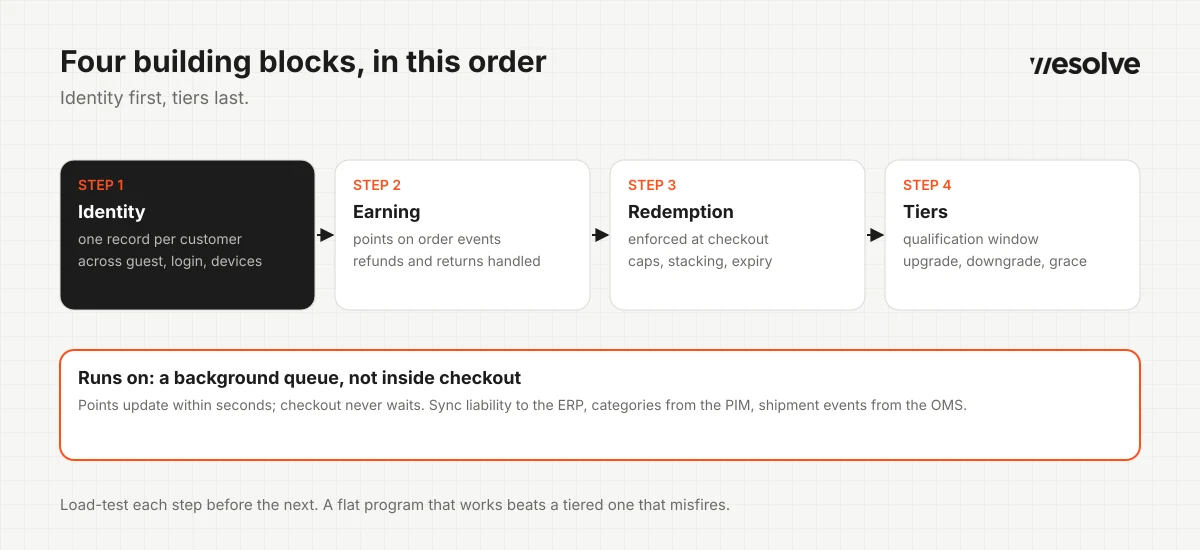
A 200ms calculation can take 2 seconds during Black Friday. If it runs inside checkout, checkout slows down. Calculate points asynchronously: the order completes, a background queue updates the balance within seconds, and checkout is never blocked. That needs a healthy message queue under load. See cron and queues.
A loyalty program that fails during a promotion is worse than none: customers who don’t see their points contact support and lose trust. Uptime is a loyalty feature. If your infrastructure can’t handle peaks, fix that first. Adding complexity to an unstable foundation doesn’t stabilise it.
Mechanics by sector
| Sector | Buying pattern | What tends to work |
|---|---|---|
| Beauty | Frequent replenishment, brand affinity | Tier maintenance, birthday rewards, early access |
| Grocery | High frequency, low margin | Simple cashback on spend; no complex tiers |
| Pet care | Regular, emotional | Rewards for subscriptions and auto-replenishment |
| Fashion and home | Infrequent, bigger baskets | Status perks: early access, free returns, styling |
| Toys | Seasonal, gift-driven | Reward the buyer; handle spikes without distorting tiers |
What to build first
- Identity: clean, deduplicated customer records before any points
- Earning: test the earning events in isolation
- Redemption: it touches checkout, your highest-stakes flow, so test it thoroughly in staging
- Tiers last: the most complex and least urgent. A flat program that works beats a tiered one that misfires.
Load-test each stage before the next. An engine that handles 100 concurrent checkouts may not handle 1,000.
At wesolve, the engineers who write the loyalty logic also run the infrastructure it runs on, so queue problems and failed events are caught before customers notice. See managed Magento hosting, or talk to us about your program.
FAQs
Which Magento loyalty extension is best? Several well-maintained Magento 2 extensions cover earn-and-burn. Choose by your qualification logic, integrations and whether you need multi-store support.
Can loyalty work across several storefronts? Yes, with a shared identity layer and a loyalty engine above the individual Magento instances.
Does loyalty slow checkout? Only if points are calculated during checkout. Calculate them in a background queue.
How do I prevent loyalty fraud? Deduplicate identities, account for return windows in redemption rules, and rate-limit sign-up and referral bonuses from the start.