

Building an online store in Greece is a legal, operational and commercial commitment, not just a technical project. The requirements are specific enough that getting them wrong costs customers, fines or both.
Greece follows EU law (the eCommerce Directive, GDPR and the Consumer Rights Directive), but Greek implementation has its own details: tax authority requirements, local payment habits and consumer protection enforcement that a generic “EU-compliant” build doesn’t automatically cover. And most connected Greek consumers now buy online, so it’s a mainstream market, not a niche.
This is practical guidance, not legal or tax advice. Confirm specifics with your accountant and legal adviser.
Legal requirements
GDPR and cookies
Consent must be real: specific, revocable, logged, and given before non-essential cookies load. No pre-ticked boxes. For a Greek-language store, the privacy policy must be in Greek, name the data controller, explain what’s collected and why, and how to exercise rights. Full detail in Magento GDPR.
Consumer rights at checkout
Before and during checkout, the store must show:
- The seller’s full legal name and address
- The total price including VAT and delivery before the order is confirmed
- Delivery timeframes
- The 14-day right of withdrawal for most products
- A final button that makes the payment obligation clear
That last point is often missed. The button must make clear the customer is placing an order with an obligation to pay, so “Order and pay” or an equivalent Greek phrase is the safe standard; a bare “Continue” isn’t.
VAT and myDATA
Greek VAT is administered by AADE. Greek-registered businesses must transmit their invoices and retail receipts to AADE’s myDATA platform, so the store and its order or ERP system need a myDATA integration. This is a back-office integration, not a checkbox on screen, and it affects how orders flow. Rates are 24% standard, 13% reduced and 6% super-reduced.
Selling into Greece from another EU country? The EU One-Stop Shop (OSS) covers distance-selling VAT, but your store still has to recognise Greek customers and apply the right rate.
Mandatory seller information
Clearly accessible, not buried:
- Business name and registered address
- VAT number (ΑΦΜ)
- Contact details, including email
- Trade register details (ΓΕΜΗ) and any sector authorisation
Payment methods Greek shoppers expect
- Cards, widely used, with interest-free instalments (for example 3 or 6 months) expected on bigger orders
- Cash on delivery (αντικαταβολή), still meaningful, especially for first-time buyers who don’t yet trust the store
- Bank transfer, common for higher values; checkout must hold the order cleanly until payment arrives
- BNPL, growing
Not every global gateway supports Greek card instalments natively, so gateway choice matters. More in Eshop Magento.
Language and localisation
Greek content isn’t optional for a Greek audience: products, categories, checkout, errors, emails and account pages. A store that switches to English mid-checkout loses the customer. Greek address structure also differs from Magento’s default form; if the form doesn’t match, people drop off.
For Greek and international audiences together, Magento store views give separate languages, content and emails from one codebase. See multistore setup.
Performance for Greek shoppers
- Low latency to Greek users, not just “somewhere in Europe”
- Autoscaling for Black Friday and the Greek sale periods
- A CDN serving assets quickly to Greek networks (CDN setup)
- A lightweight frontend like Hyvä: Luma is too heavy for competitive Core Web Vitals on mobile
New build or replatform?
A new build can design compliance in from day one. A replatform from an older system reveals the gaps: an old Magento 1 store almost certainly has no myDATA integration, outdated cookie consent and a checkout button that doesn’t meet the consumer rules. A replatform is the moment to close them all at once, not to patch them after go-live. See the replatforming checklist.
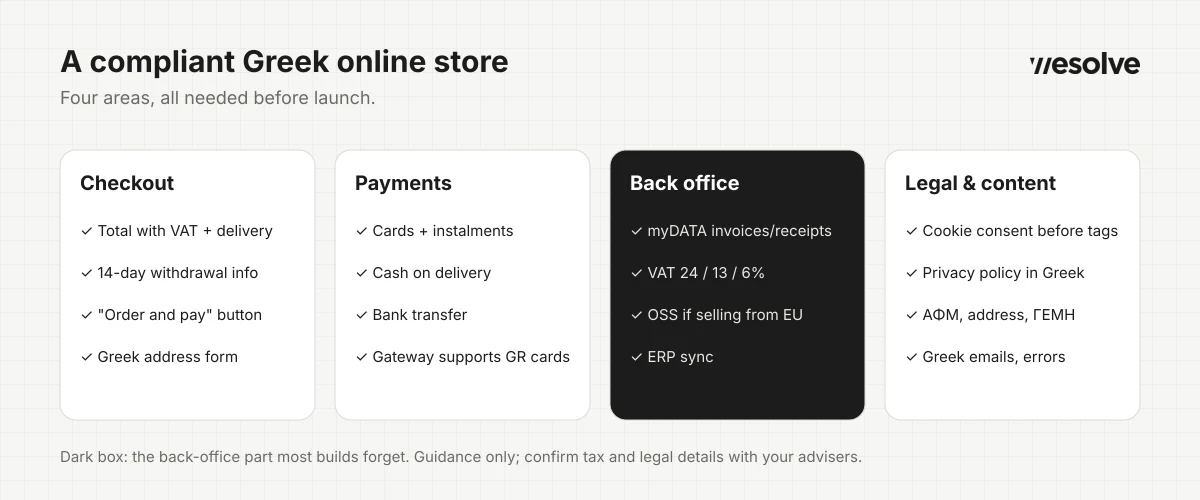
The checklist
- Real opt-in cookie consent
- Greek privacy policy with controller details and rights
- Total price with VAT and delivery before confirmation
- Withdrawal information and a compliant final button
- myDATA integration for Greek-registered businesses
- OSS registration when selling into Greece from elsewhere in the EU
- Seller details: ΑΦΜ, address, contact
- Greek checkout, emails and error messages
- Greek address form
- Cash on delivery, bank transfer and card instalments
- Infrastructure sized for peaks, close to Greek users
Each item needs specific development or a specific integration. wesolve builds and runs Magento stores for the Greek market, with myDATA integrations, Greek payment gateways and Hyvä builds from one team, so nothing falls between vendors at 2am on Black Friday. See how we work in Greece, or talk to us.
FAQs
What legal requirements apply to an online store in Greece? GDPR, the Consumer Rights Directive and the eCommerce Directive: real cookie consent, total price before confirmation, 14-day withdrawal and visible seller details. Greek-registered businesses also transmit invoices and receipts to myDATA.
Is myDATA integration mandatory? For Greek-registered businesses, invoices and receipts must reach AADE’s myDATA. Confirm the details with your accountant.
Which payment methods should I offer? Cards with instalments, cash on delivery and bank transfer at minimum.
Does the store have to be in Greek? For a Greek audience, yes, including checkout, emails and error messages.